
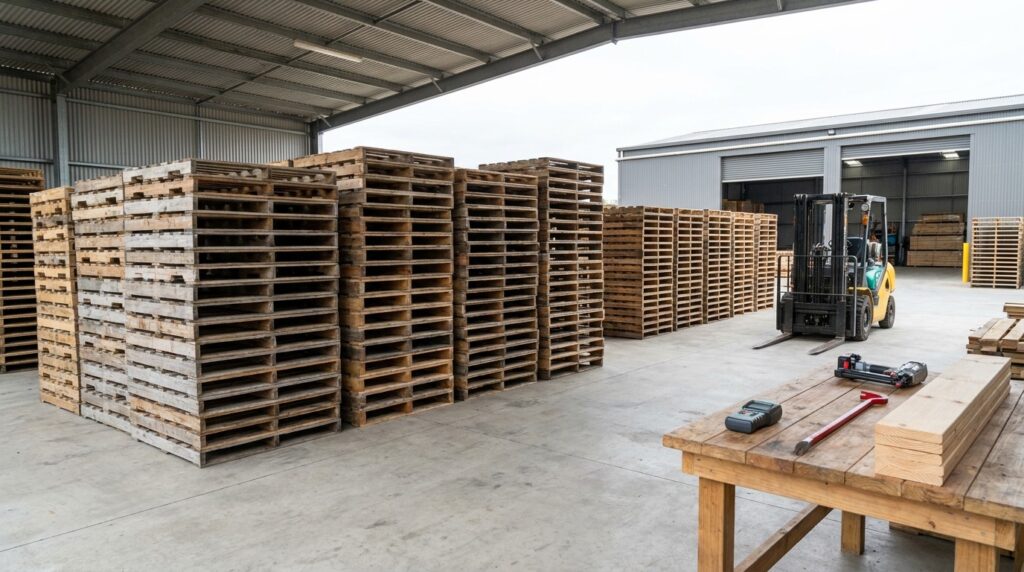
Questions to Ask Before Ordering Reclaimed Pallets
A cheap pallet stops being cheap the moment it tips a load or cracks under a forklift. When you buy reclaimed timber, the unit price tells you very little. You need to ask sharper questions before placing an order.
Ask what the pallet carried before you
Reclaimed timber has a past, and that past stays in the wood. A pallet that carried sealed cartons in a dry shed is a very different buy from one that sat in a wet yard or moved chemicals. Moisture soaks into deck boards and feeds mould. That mould creates food safety problems and softens fibres you can’t see.
Ask the supplier directly what service stream the batch came from. Good suppliers will tell you whether stock came from bagged goods or carton handling. They’ll also flag anything that touched food or chemicals. If they can’t answer, treat that as your answer. Don’t put unknown timber under packaged food or pharma loads.
Water damage is the quiet killer here. Boards can look solid while the stringers have gone soft at the nail line.
Ask how long the pallets sat outside, along with how the supplier dries and stores inbound stock. A supplier with covered storage and fast turnover will provide drier timber. A supplier with open stacks after rain won’t, and you’ll pay for it through broken cartons and rejected loads.
Smell the timber and check for stains. Chemical spills leave marks and odours that don’t wash out, while food residues draw pests. If you see black spotting or soft patches, walk away from that batch for sensitive loads.
Ask whether the supplier segregates food-grade returns from industrial returns. Mixed yards blend everything. Segregated yards reduce cross-contamination and give you a cleaner pick for carton work.
Single-trip pallets often look neat, but they were built light. Multi-trip pallets were built to cycle. Ask which stream you’re buying from because light single-trip timber won’t take the same knocks.
Ask for photos of the actual stacks rather than marketing shots. Look for even heights and clean edges. Uneven stacks suggest mixed sizes, while dirty edges often point to yard storage.
Ask how the supplier grades its stock
Pallet grading sounds official, but it isn’t. One supplier’s B-grade is another supplier’s scrap, and you can’t tell the difference from a phone quote. Basic reclaim is the loosest grade in most yards.
Ask for it in writing.
You want clear cull rules. Find out how many split boards are allowed per pallet and how many protruding nails or cracked stringers trigger a reject. A straight supplier will give you numbers. We hear too many vague promises about good, usable stock, and those loads usually disappoint.
Photos don’t settle this. You need to handle the timber or get a sample that shows the worst of the batch as well as the best.
Ask whether repaired boards are marked and how repairs are logged. A sound repair uses full-length replacement timber and proper nails. Filler and short patches won’t hold under a standard load.
Ask for a one-page specification you can file. It should state deck gaps and nail flushness, as well as the reject rate the supplier accepts during sorting. When that specification is missing, disputes tend to drag on.
Push on edge cases. Find out what happens when a pallet has both a cracked bearer and a popped nail. Does it ship, or does it get pulled? Clear answers here stop arguments on the dock.
Ask about volume consistency. One good delivery proves little. Check whether the next three loads will match the sample. Suppliers with steady inbound streams can promise that, while others can’t.
What basic reclaim actually means
Most buyers overthink grade names and underthink job fit. Start with the job. Floor storage with light cartons is very different from racking with drums. Basic reclaim fits the first job. It was never meant for the second.
Basic reclaim is straightforward. It’s a used pallet that has been collected and sorted. It may have had a quick repair, but it has not been rebuilt to a premium specification.
When suppliers talk about Basic Reclaim Pallets Melbourne, they usually mean sound, sorted stock that suits dry storage and standard carton loads where racking strength isn’t required. That keeps costs down while keeping good timber in work. It’s a practical choice for one-way dispatch or floor stacking in a warehouse.
Don’t expect block pallet strength here. Most basic reclaim is stringer construction. That’s fine for floor loads, but it won’t pass for heavy racking.
Block pallets take harder hits and allow four-way entry. Stringer pallets are lighter and cheaper. Ask which type dominates the batch because forklift drivers feel the difference on every turn.
Reuse is the point. There are more than 1.8 billion wood pallets in circulation in the United States alone (National Wooden Pallet & Container Association). At that scale, the circular economy starts with repair and reuse for low-risk jobs. We keep pallets moving when the job fits the grade.
Ask about load rating and where you can’t use it
Every pallet has a limit, so ask what it is. A basic reclaimed pallet rarely has a tested Safe Working Load (SWL). If the supplier quotes one, ask how it was established.
Most basic stock is built for floor contact and short forklift moves with evenly distributed carton weight. It is unsuitable for racking beams or double stacking heavy drums, where failure can hurt people and wreck stock. There’s no shame in that limit. Problems begin when buyers assume rackable strength that was never promised.
Ask how the weight should sit. Evenly spread cartons are kind to reclaim. Point loads from feet or drums punch through weak decks. If your load concentrates weight, you need heavier stock.
Check whether any load advice is written down. Verbal limits get forgotten during a busy shift, while written limits can stay on the wall. Our rule is simple, and we like suppliers who state clear no-rack rules for basic grades.
Ask about fork pockets next. Cracked entry points and loose blocks let tynes twist. That twisting action can split a load in an aisle.
Fork entry damage is difficult to repair well. Ask whether the supplier rejects pallets with crushed entries. Patched entries may look tidy, but they can split again under the first heavy lift.
We see failures tied to manual handling and load stability. That’s a WHS call as well as a cost call. Ask whether the grade is rated for racking or stacking. If the answer is no, believe it and use the right pallet for that job.
Ask about size consistency and treatment marks
Nominal size means little in reclaim. Timber shrinks and swells, and boards are often swapped. A batch can drift by 10 mm or more.
Ask whether the load is all 1165 x 1165 mm or all 1200 x 1000 mm, then check what tolerance the supplier works to against AS 4063 dimensions so the pallets still fit your racking and wrap lines. Mixed sizes cause overhang. That overhang snaps cartons and causes faults in automated handling.
Ask about stamps first. ISPM 15 compliance determines whether timber packaging can cross borders. Look for HT marks showing heat treatment. MB marks indicate fumigation, and buyers with food loads often reject them.
If your freight stays local, stamps may not matter. If there’s any chance of export or long transit, don’t risk unstamped timber.
Ask whether reclaimed sizes still line up with AS 4063 construction. Years of repairs alter dimensions, and shrinkage opens gaps quickly. A tape check across ten pallets tells you more than the nominal size shown on an invoice.
Export adds real risk. Unmarked pallets can be turned away. Ask the supplier to pull only stamped stock for those orders, and keep domestic reclaim separate from export-ready stacks.
Wrapping hides size drift until something fails. Loose film lets cartons move, while tight film crushes overhang. Ask for a trial wrap using your film settings before committing to volume.
Ask how inspection and repair works
Sorting makes or breaks reclaim. Ask who does it and where the work takes place. A proper yard has a set inspection bay, and rejects never bleed into good stacks.
You need to know what gets culled on sight, including split stringers and lifted nails. Ask whether repairs use full replacement boards with correct nailing patterns that hold under weight. Ask to see the repair bench.
It’s been seen that yards patch pallets with offcuts and hope for the best. That timber fails early. Good suppliers remove the damaged board, fit a sound replacement and re-nail it to pattern.
Ask how moisture and mould checks fit into that process. A quick visual pass won’t catch soft timber that was wet for weeks.
Find out what tools the sorters use. A moisture meter finds wet boards quickly, while a pry bar identifies loose nails. Yards that rely on eyesight alone miss defects that basic tools catch in seconds.
Ask how often blades and nail guns are checked. Poor tools split timber, and split timber fails under vibration in transit. Good maintenance shows in cleaner repairs.
Ask who trains new sorters. Experience shows in quick, accurate rejects. New hands need clear photo guides. Without training, bad pallets slip through.
Ask about replacements, samples and the reuse loop
Broken deliveries still happen. What matters is how the supplier responds. Ask who pays return freight on culls and what proof is needed for a credit.
You should hear a plain answer about timing and evidence. Expect photos of damage on arrival and credit on the next run. Get that policy before you pay.
Ask for a sample pallet. One unit tells you more than a specification sheet. Go further if you can and walk through the yard. You’ll see the grading process in action.
Ask about the loop after delivery. Check whether the supplier takes back sound pallets for credit and grinds the dead ones for recycling. That buyback keeps timber in use. It can also cut your waste bill.
For local runs, ask about minimum orders and lead times. Delivery cost can dwarf unit savings on small drops. A supplier close to your site with set run days will often beat a lower unit price from farther away.
Ask about ongoing supply. Can the supplier hold your size each week? Swapping sizes mid-contract breaks your wrap settings. Consistency matters more than a one-off bargain.
Stop buying on unit price alone. Buy on job fit and honest load limits. The right questions take ten minutes and can save you a failed delivery. That discipline is what makes reclaim pay.